Tuesday, May 30, 2017

My Summer Greens


Moringa tree starting to bud out in 
March after a severe pruning
in winter to 4 ft.

I
thought it would be slim picken's for greens in my garden once all my winter greens (lettuce, arugala, kale, bok choi and chard) dried up due to the rising temperatures.  But as the summer heat intensifies, so does the growth of my "summer greens".
It started in March with my Moringa Trees springing back to life after a severe winter pruning.  Also called Miracle Trees, they live up to their name.  It is truly miraculous how quickly they grow back once it warms up outside!  By April we were already drying a new fresh crop of moringa leaves to make moringa powder. I've been energized this summer by having moringa salads, moringa in stir fries, moringa soup, moringa smoothies, and even moringa cookies!  And now in May I am just starting to harvest the young moringa pods, or "drumsticks", steamed, sauteed or stir-fried, they taste just like asparagus!

The same Moringa tree towering over the
fence by the third week in April!
Another summer green that will kick into high gear when we start staying in the triple digits is Malabar Spinach.  Not a true spinach but more of a succulent vine, its not only good to eat, its also pretty to look at! If you don't care for the texture of the leaves you can always add the leaves to smoothies. Malabar spinach vines start out slow, so be patient.

Malabar spinach in October 2016
Egyptian Spinach also does well in the heat.  I'm growing it for the first time right now and my starts are still tiny.  When fully grown they will be about 2 or 3 feet tall and bushy.

Egyptian spinach.  (Photo from web)
Young sweet potato leaves are in good supply right now in my summer garden and are a great substitute for spinach or lettuce in salads.

Flowering Sweet Potato vines, May 2017

Dandelion Greens might be an acquired taste for some, but if cooked properly they can be delicious.  My favorite way to eat them is sauteed and served with Dill Roasted Red Potatoes.  Be sure to grow them in pots or planter boxes because they are invasive, and try to gather the puff-ball of seeds before the wind blows them all over your garden!

Dandelion Greens in redwood planter box.
Soon Purslane will be popping up in mounds all around the yard, in cracks, among rocks and cactus, as it seems to love poor soil and rough conditions.  I eat the purslane raw as an addition to other greens in my salads.

Purslane growing in my rocky cactus and agave bed
next to the swimming pool
I also have my good old perennial Tree Collards to rely on for a steady supply of greens year round.  In the summer I use big collard leaves for wraps instead of using tortillas.

My Tree Collards as of May 2017
My tiny little Tree Collard starts in February 2015

So there will be no store-bought lettuce or spinach for me this summer :-).  I've got a steady supply of fresh-picked greens right from my garden!


Friday, March 3, 2017

Early Spring Gardening Angst

I should be excited about planting my tomato starts.  Started from seed, I've nursed these fuzzy buggers along for over a month indoors - Super Sioux, Pineapple, Stupice, Cuastralee Beefsteak, Cossack Pineapple Tomatillos, and Poha Ground Cherries. Now they lurk in front of my enclosed garden, ready to move in and take over. 
But that means I must say goodbye to my wonderful winter crop of lettuce, chard, and arugula.  I'm not good at the eviction process.
  I've been eating fresh salads for weeks now, tossing in herbs, nasturtium  flowers, snap peas, moringa, dried figs, peppers, and kohlrabi, all from the garden.
Of course I will keep my herbs, like dill, cilantro, parsley, anise, tarragon, and thyme.  I also cannot evict the flowers that are popping up as they are all good companion plants for the tomatoes - marigold, borage, and sunflowers.
The enclosure is prime real estate in my garden, a safe harbor for the more delicate plants to thrive without fear of being tromped or munched on by the various critters that pass through my yard.


 So every season there is the angst of who will stay, who will go, and when.


Tuesday, November 22, 2016

Dig It Urban Gardens Nursery - I Dig It!


The remains of a member of the Blue-Man
group who refused to eat organic veggies.

  I am really digging it at Dig It Urban Gardens Nursery!  This is a nursery in a class by itself.  I was agog the minute I left my vehicle.  The entire north side of the nursery is a beautiful lush edible landscape, on the OUTSIDE of the fence.  The nursery storefront has a gorgeous street-art style mural painted on it.  My photos don't really do it justice.

Once inside the Dig It store I found myself looking all around and just repeating "WOW!".  One area had awesome vivariums and terrariums loaded with plants.  As I stared into one of the vivariums I suddenly saw two bulging eyes staring right back at me - a tiny green and yellow frog!


Another corner of the store had the biggest display of air-plants that I have ever seen!
  Dig It carries over 40 varieties of these crazy soil-less plants.

Another view of the uber cool Dig It storefront.

An amazing selection of organically grown plants starts!

Fabulous selection of pots!


Dig It has more butterflies than any garden center in the Valley.  Its no wonder why - they sell a huge variety of milkweed including one I've never heard of - Sodom Apple.  They also have on display butterfly cages that you can fill with milkweed plants and butterfly caterpillars, then wait to see the chrysalis form and the butterflies emerge! The large leafed plant in the butterfly cage below is the Sodom Apple Milkweed.

"Butterfly Cage" is actually a chameleon screened cage with
the bottom cut out, a great idea!

  Since opening in October 2015 Dig It has held a number of classes
including classes on herb gardening, composting, summer gardening
in the desert, butterfly gardening, creating a vivarium,
growing and caring for aloes, container gardening, and rose gardening,
To keep up on what is happening next at Dig It, stay tuned to their FB Page.

You can even shop in their greenhouse, but be careful not to disturb the young plants starts and seed start trays - not everything is for sale yet.  Ask before you grab :-)


More beautiful street art, featuring our endangered honey-bees!

Dig It's generous edible landscaping, lining the street outside their garden center.

If you haven't been to Dig It Urban Gardens Nursery you are missing out on a real treat.  I could spend hours here, there is so much to see.  Dig It is truly a community-based nursery, filling the void created when Baker's Nursery closed.  Be sure to shop local this holiday season, and head out to Dig It, at 3015 N 16th St. Phoenix Az  (602) 812-7476

To see more about Dig It and its owners Tim Bishop and Ryan Jerrell
(self-described plant nerds)
watch this great interview by McKenzie Steuber-


Friday, November 11, 2016

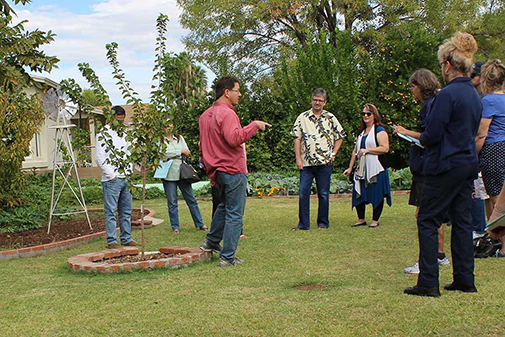
The Urban Farm Tree Tour


  Last Friday I attended The Urban Farm Tree Tour to hear the Valley's guru of desert urban farming, Greg Peterson, discuss the process he has gone though in planning and planting his own Urban Farm in central Phoenix. Over the years Greg has inspired many desert dwellers to be bold and dare try to grow fruit trees in our arid unforgiving heat, and with great success!

The tour is just part of the Urban Farm's Fruit Tree Program, and is in it's 17th year!  The program offers classes, online and in person, to help you in planning your orchard layout and in selecting the trees that will best thrive in our climate.
Local media was there interviewing Greg Peterson about the
Urban Farm's Fruit Tree Program, helping to spread the gospel of
good sustainable urban farming!
Greg pointed out a number of things I wish I had known BEFORE I planted my fruit trees.  First is to plant fruit trees with a short ripe period (like peach and plum) close to where you hang out in your yard so you can easily spot the ripened fruit before the birds do.  Fruit trees like citrus and apples which hold their ripe fruit much longer can go towards the back recesses of your yard.

Another thing I never knew was that its good to thin the fruit on your trees.  Greg's method is to just shake the tree :-).  Thinning the fruit allows the remaining fruit to fully mature, and grow a bit larger, that way you don't end up with an over-stressed tree full of half-grown fruit.

Greg also pointed out that if you are low on space, you can successfully plant 3 trees in one hole.  You will want to do some research on which trees are compatible, consider varied ripening seasons, and do plenty of pruning to not let one tree dominate.
I love that Greg saved and re-purposed the dead grapefruit tree
that had originally supported a single grape vine, using it now to support
one side of a now sprawling grape arbor.
The bare root fruit trees will be available at The Urban Farm's pop-up nurseries through January, February, and March, right at the time you need to plant them.  I'm running out of room in my yard so I had to restrain myself and only buy 3 trees - a Pakistani Mulberry, a Bearrs Lime, and a Tango Mandarin.  If you are ready to order or just want to check out the selection, go here. 

Another tidbit of info before you order - if you are an orange lover and want to extend your harvest, consider planting a Trovita Orange, they ripen in February and March!
The next hands-on class is Fruit Tree Pruning on Saturday Dec. 10th from 9am to 11am at The Urban Farm.  To attend sign up here.


Special thanks to Greg Peterson and his crew at The Urban Farm for an awesome tour and for helping us desert rats grow fruit in the valley of the sun :-)

Wednesday, November 2, 2016

Hand Pollinating Passionfruit


My Passion Fruit (Passiflora edulis) vine's first bloom!  I'm not sure its necessary
but we went ahead and hand pollinated it per the instructions
in the video farther down below.


The flower was closed in the next day or so.


A week or so later we spotted the fruit!  Since I've had trouble with birds,
squirrels and insects attacking my figs and pomegranates I went a bit overboard
and protected it with a drawstring organza bag.


Monday, October 17, 2016

AZRFG Fall Plant Sale 2016


  Last Saturday was the Arizona Rare Fruit Growers Fall Plant Sale, held at Mesa Community College's Rose Garden - a perfect venue for selling tropical plants!  There was plenty of shade and the garden seemed to have its own little micro-climate.


There was quite a variety of dragon fruit plants for sale, and experienced growers on hand to give great (and in my case - much needed!) gardening advice.


Plenty of happy customers searching through a huge variety of rare and tropical plants.  I should have taken notes but was busy gawking at plants I had never seen up close before - Okinowan spinach, starfruit, banana plants, pineapple, jujube, panache tiger stripe fig, shangri la mulberry, white mulberry, jaboticaba, coffee tree, cinnamon tree, sugar apple, and an enormous variety of pomegranate trees.


They even had moringa trees, seen on right side of the above photo.


This young gardener had his hands full tending to his new trees and soil amendments!


Jake Mace was there with his new best friend - his selfie stick!  Jake has started broadcasting live, catch him at Jake Mace Live Stream on YouTube.


Happy customers leaving with trees from Shamus O'Leary's Tropical Fruit Trees.  

If you missed out on this opportunity to buy from Shamus, you will have one more chance this coming weekend at Jay Barringer's Food Forest Exploraganza and Workshop 
Saturday Oct. 22nd, 9am - 11am, in east Mesa at 41 S 83rd Pl, Mesa, AZ 85208  Also available will be Jay's Orchard Gold Mix,
Shamus's compost/lava sand mix,  Shamus's Foliar Feed, Azomite, and

Mycorrhizae. 


Kudos to the Arizona Rare Fruit Growers for putting together a magnificent plant sale and having so many helpful and knowledgeable members on hand to assist buyers!  This is a great group to learn from, so consider joining and attending meetings.  Meetings are held on the 2nd Thursday of every month at MCC from 7:30 PM - 10:30 PM.

Friday, October 7, 2016

Flower Street Urban Garden Tour


Flower Street Urban Garden's planter wall on 44th street overflowing with 
vibrant sweet potato vines.  These vines grew during the hottest part of the
summer in Phoenix on a west-facing block wall!

I have always wondered what laid behind the beautiful planter covered block wall on 44th Street near Thomas in Phoenix, so I jumped at the opportunity when I heard they (Flower Street Urban Gardens) were giving tours on Saturday.  The tour started in the front yard with Alex Billingsley  (the proprietor) explaining the thought that went behind the positioning of the gorgeous redwood raised beds.  He had waited for winter solstice and marked off where the house's shadow ended, and set up the raised beds just beyond that.  That way, even during the shortest days of winter, the garden beds would get the maximum amount of sunlight possible.

I always learn something useful when I go on a garden tour, but on this particular tour I learned A LOT! Alex was just chock full of useful information.

First was to beware when filling / amending  your fall garden beds with store-bought "organic" compost or mulch.  Watch out for ones that include "bio-solids" - another word for sewage-sludge!  Ewwwww!!!  Human waste actually isn't the worst part of sewage-sludge, what is really bad are all the toxins from auto repair shops, salons, prescription drugs, etc. that get washed into the sewers and then become concentrated in the sludge.
Two brands to steer clear of are Kellogs and Miracle-Gro.  For details see Sludge News.  A local company you can trust is Western Organics based right here in Phoenix selling under the brand names Garden Time, Nature's Way, OMNI, Organo and GRO-WELL Soils. When sorting through other brands, look for any warning to wear gloves while handling, which means they added sewage-sludge.  Any product with the OMRI (Organic Materials Review Institute) seal of approval on it is guaranteed to not contain sewage-sludge. 

The second nugget of info from Alex was regarding the use of bricks or cinder-block in constructing garden beds.  Some may contain "fly-ash" a byproduct from the coal production industry, containing heavy metals which over time may leach into your garden soil.  The EPA claims the amount is "negligible", but our EPA isn't as trustworthy as in years past.  The EPA has sadly and dangerously transitioned from being a regulator of industry into a partner of industry.  So buyer beware if you are buying bricks for your garden beds!

These vertical beds are on a south facing block wall
and are still going strong after a long hot Phoenix summer!
Back to the garden tour - I must admit that I had always been skeptical of vertical gardens doing well here in the Sonoran Desert.  My thinking was that the hot summer sun would heat up the block wall, and the heat radiating from the wall would bake and kill the soil and plants in the wall mounted bed.  But Alex explained that the vertical garden beds with their incorporated drip irrigation lines, actually cool the wall, and after seeing the lush growth in Alex's beds at the end of a long hot summer, I'm sold.

Flower Street Urban Gardens offers even more than their signature vertical garden beds.  They also build beautiful sturdy redwood raised beds (as seen in a few photos above) and offer garden planning, installation, planting, irrigation, and upkeep!

Being in a wheelchair, I just LOVE their vertical garden on wheels!
I could get my face and hands right in there
with the plants, bugs, blooms, and bees :-)
 

 Also at the tour was Synergy Steel, with great looking steel trellises, steel planter boxes, and cute little chicken coops.  I almost bought a coop and I don't even have chickens!